




A client sat across from me last month and asked the question I get more than any other: “How long is this actually going to take?”
She’d filed her VAWA self-petition almost three years ago. She had a prima facie letter. She had a work permit. But she didn’t have an approval, and she was tired. Tired of waiting. Tired of checking case status at midnight. Tired of feeling like USCIS forgot her.
Here’s what I told her, and here’s what I’m going to tell you: the wait is real, it’s longer than it’s ever been, and it’s not a sign your case is in trouble. But you also can’t just sit there. There are things you should be doing right now while USCIS does its part and most people aren’t doing them.
Let’s get into it.
Quick note from me before we go further
I’m Ayesha Chidolue, the founding attorney at The Chidolue Law Firm. I’ve been practicing immigration law for years, and a big part of what we do is VAWA self-petitions, helping survivors get out from under abusers who used immigration status as a weapon. I’ve represented clients in family-based, humanitarian, and removal cases, and I’ve sat across the desk from hundreds of people who came in scared, confused, and convinced their case was hopeless.
So if you’re reading this with a knot in your stomach, take a breath. Here’s what’s actually happening in 2026.
What’s actually happening with VAWA processing times in 2026
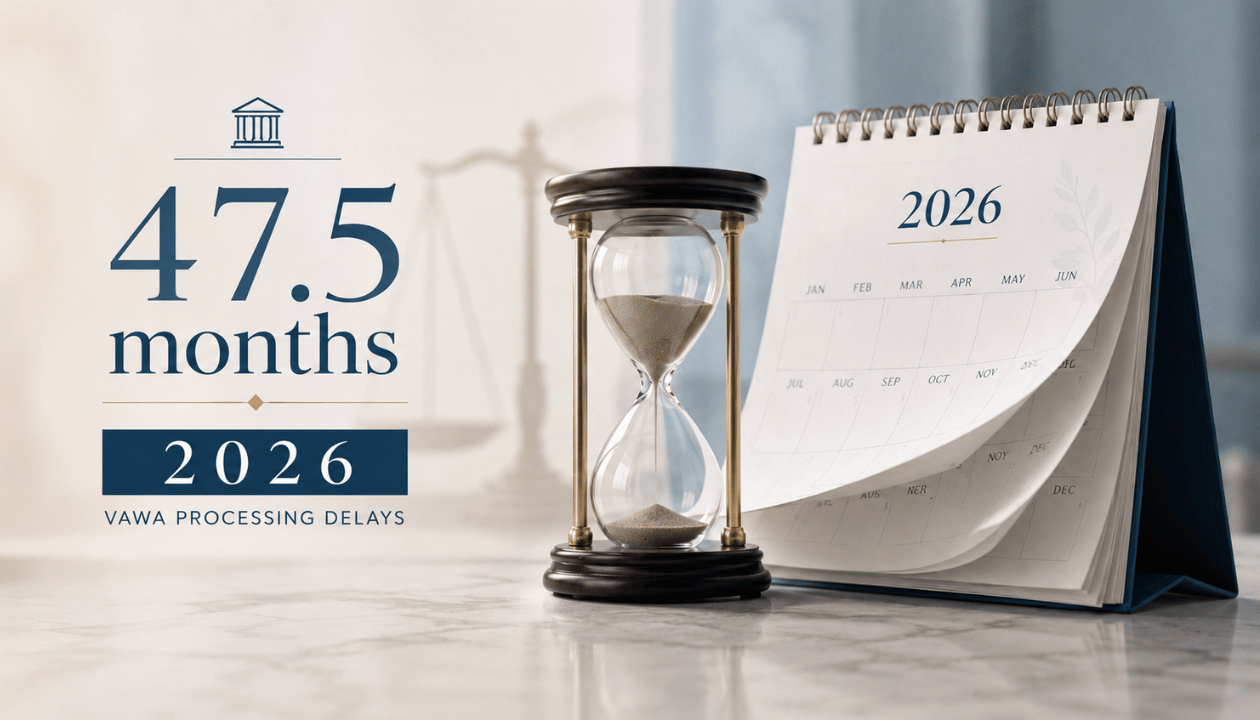
Here’s the bottom line: according to USCIS’s March 2026 processing-time data for Form I‑360 at the Nebraska Service Center, roughly 80% of VAWA I‑360 self-petitions are being completed within about 47.5 months, almost four years to reach a decision. That’s up from about 41.5 months in early 2025 and roughly 30 months back in fiscal year 2023.
So in three years, the average wait has grown by a year and a half. That’s not a small slip. That’s a system getting slower while filing volume keeps climbing USCIS and stakeholder reports indicate that VAWA I‑360 filings have increased sharply between fiscal years 2020 and 2024, with some sources estimating an increase of about 360%; exact figures vary by dataset and should be confirmed with the latest USCIS or DHS statistics.
A few things are happening at once right now that anyone filing in 2026 needs to understand:
- The HART unit owns every VAWA case now. Since April 1, 2024, every new VAWA self-petition routes through the Nebraska Service Center under the new HART (Humanitarian, Adjustment, Removals, Conditions, Travel Documents) unit. The idea was to centralize humanitarian casework under specialists. The reality, so far, is a unit that’s still staffing up while the backlog grows.
- A December 2025 USCIS Policy Manual update tightened evidentiary review. Officers are now specifically trained to scrutinize affidavits for “templated” or recycled language. If your declaration sounds like 50 other declarations, you’re getting an RFE. (More on what this means for your case below.)
- Prima facie determinations are no longer guaranteed. Following a September 2025 USCIS memo, many cases are now being decided without a prima facie notice issued first, or the notice is coming much later than the historical 3-9 month window.
- Some cases now get interviewed. Since late 2024, USCIS started conducting interviews for certain VAWA self-petitioners, primarily those who filed I-360 and I-485 concurrently. Stand-alone I-360 cases are usually not interviewed.
So when I tell you 47.5 months, I’m not just quoting a number. I’m telling you what your case is walking into.
Why VAWA cases take this long (and why “just be patient” isn’t the right answer)
Most articles you’ll read about VAWA processing times will tell you the same thing: it takes a long time because of high volume and confidentiality protections. That’s true. But it’s not the full story.
In our practice, here’s what I see actually driving timelines:
1. The volume problem is real, but it’s also a staffing problem
USCIS isn’t deliberately slow-walking VAWA cases. They genuinely have more filings than people to review them. The HART unit was supposed to fix that, and to its credit, it does provide more specialized review. But staffing hasn’t caught up to filings. The American Immigration Lawyers Association (AILA) and other observers have warned consistently that internal hiring isn’t keeping pace.
2. RFEs are now the norm, not the exception
Listen, five years ago, a clean VAWA case could get through without an RFE (request for evidence). Today? I’d estimate roughly half the cases we see at other firms come in with an RFE history, and that’s after the December 2025 tightening kicked in. An RFE adds anywhere from 2-6 months depending on how fast you respond and how complete your response is.
The thing is, many RFEs are preventable with a thorough initial filing and careful documentation. They happen because the initial filing was thin. Police records were missing. The personal declaration was vague. Joint financial proof was a single utility bill instead of a real paper trail. USCIS isn’t being unreasonable; they’re applying a stricter review standard than they were two years ago, and people are filing the way they used to file.
3. Receipt notices alone now take 6-7 months
This one catches people off guard. You file your I-360, and then you wait. And wait. In 2021, a receipt notice typically arrived in 4–6 weeks. In 2026 we are seeing receipt notices often take 6–7 months to arrive, reflecting longer processing windows than just a few years ago. There are no filing fees on a VAWA petition, so unlike a marriage-based case, you can’t even watch a check clear to confirm receipt. Tracking your certified mail receipt is sometimes the only proof you have for half a year.
4. The “totality of the record” standard means consistency matters more than volume
USCIS’s updated guidance puts heavy weight on whether your evidence is consistent, not just whether there’s a lot of it. If your declaration says one thing and your medical records imply another, or if your timeline doesn’t match across documents, you’re going to draw more scrutiny than someone with less evidence that all points the same way.
Real talk: I see people obsess over how much evidence to submit. The volume is not the point. A 200-page packet that contradicts itself is worse than a 60-page packet that’s airtight. USCIS officers are reading for consistency now. Build the file like a story that holds together not a folder where you threw in everything you could find.
The real 2026 VAWA timeline, stage by stage
Here’s what you can realistically expect at each phase, based on what we’re seeing in cases this year:
Stage 1: Filing to receipt notice → 6 to 7 months
You mail your I-360 packet with everything supporting it. USCIS eventually sends Form I-797C with your receipt number. This is taking 6-7 months in 2026. Keep your certified mail receipt for most of that period, it’s your only proof you filed.
Stage 2: Biometrics → 1 to 3 months after receipt
Once you have a receipt number, USCIS schedules biometrics (fingerprints and a photo). This is one of the few parts of the process that’s still moving close to historical norms. If you don’t get a biometrics notice within 3 months of receipt, that’s a flag worth raising with an attorney.
Stage 3: Prima facie determination → variable, sometimes never
This used to come 3-9 months after filing. After the September 2025 USCIS memo, prima facie determinations are now often delayed past 12 months or skipped entirely. USCIS is moving more cases directly toward full adjudication without issuing a separate prima facie notice first. If you do get one, it lets you access certain public benefits (housing assistance, some state-level support) while you wait. If you don’t get one, that’s not a sign anything is wrong, it just means USCIS is going straight to final review.
→ Read more about what a prima facie determination is and what it actually means for your case
Stage 4: Work permit (EAD) → 3 to 8 months after eligibility
Important: A pending VAWA petition does not automatically give you work authorization. If you requested a C31 EAD by checking the employment authorization box on your Form I-360, USCIS may issue that work permit once your VAWA petition is approved. However, a C31 work permit is generally not available while the I-360 is still pending. If you are also eligible for adjustment of status and have filed Form I-485, you may be able to apply for a work permit separately under the C9 category using Form I-765 while your adjustment application is pending. Processing times vary depending on the category and USCIS workload.
→ See our full VAWA work permit timeline 2026 for category-by-category EAD guidance
Stage 5: Final I-360 decision → 47.5 months (median for 80% of cases)
This is the big one. USCIS reports that 80% of VAWA I-360 petitions are completed in approximately 47.5 months as of March 2026. Some cases move faster straightforward filings with strong evidence and no RFEs can come in well under that. Some take longer, especially if there are background check delays or multiple RFEs.
Stage 6: Adjustment of status (I-485) → 8 to 24 months after I-360 approval
After the I-360 is approved, you file I-485 to get your green card (if you didn’t file concurrently). Most VAWA-based adjustment cases take 12-24 months, though USCIS data from mid-2025 showed a median closer to 8.7 months for immediate relatives. If your abuser was a lawful permanent resident rather than a U.S. citizen, you may also have to wait for a visa number to become current based on the travel.state.gov visa bulletin.
Combined total — start to green card in hand: typically 4 to 5 years. Sometimes more. Rarely less.
What this looks like in real cases
I want to give you a couple of patterns we see constantly in our firm, because numbers don’t tell the whole story.
Pattern one — the “I waited because I was scared” case. We had a client come in who had been eligible to file VAWA for almost two years before she walked into our office. She was scared. Her husband was a U.S. citizen, he’d been abusive for years, and she was convinced if she filed, he’d find out and retaliate. So she sat on it. By the time she filed with us, she’d lost two years of clock time that could have been ticking toward her green card. The federal confidentiality protections under 8 U.S.C. § 1367 means USCIS cannot share VAWA filings with the abuser but knowing that and feeling safe to act on it are two different things. The fear is valid. The waiting isn’t doing what people think it’s doing.
Pattern two — the “I tried to do it myself and got an RFE I didn’t understand” case. Someone files pro se to save money, USCIS sends a request for evidence with very specific language about cohabitation evidence or financial co-mingling, and they panic. By the time they come to us, the RFE response window is half gone and the original filing is missing things that should have been there from day one. We can usually fix it, but we’re fixing it under pressure with a clock running. The lesson isn’t “everyone needs a lawyer for everything.” It’s: if you’ve gotten an RFE and you don’t fully understand what they’re asking for, that’s the moment to call someone. Not the moment to Google harder.
Pattern three — the “my prima facie never came” case. We’ve had clients call us 14 months in, panicking because everyone in their Facebook group got a prima facie letter and they didn’t. After the September 2025 memo, this is now normal in many cases. It doesn’t mean USCIS sees a problem with your file. It means USCIS is processing differently than it did two years ago.
What you should do next — in this order
If you’re sitting in this situation right now, here’s what I’d tell you to do, in order:
1. File the EAD if you haven’t. A pending VAWA petition doesn’t give you work authorization automatically. If you’re eligible for a (c)(31) or (c)(9) employment authorization document and haven’t filed Form I-765, that’s job one. You miss 100% of the work permits you don’t apply for.
2. Make sure USCIS has your current address. Use the USCIS Form AR-11 process or, for VAWA cases specifically, follow the VAWA-specific address change procedure — it has confidentiality protections built in. If USCIS sends a notice, an RFE, or a request for biometrics and they can’t reach you, your case stalls or worse.
3. Track your case proactively. Check case status online with your receipt number. If you don’t have a receipt number yet because you’re still in the 6-7 month receipt notice window, keep your certified mail return receipt safe.
4. If you got an RFE, respond fast and respond complete. The RFE will state a deadline, often around 87–90 days depending on the request; check the RFE itself and respond within that window. Don’t wait until day 80 to start working on it. A weak RFE response often turns into a NOID (notice of intent to deny), and a NOID is much harder to fight than an RFE was.
5. If your case is well past 47.5 months with no movement, escalate. Options include a case service request, congressional inquiry through your representative’s office, an Ombudsman complaint, or in rare cases, a federal mandamus action to force a decision. Each one has costs and tradeoffs.
6. Schedule a consultation if your case is showing red flags. Red flags include: an RFE you don’t fully understand, a NOID, a case approaching 4 years with no prima facie, an interview notice on a case where you didn’t expect one, or removal proceedings starting while your VAWA is pending. These aren’t situations to handle on your own.
Real talk: The mistake I see constantly is people waiting until they get a denial letter or a NOID to call an attorney. By that point, your options are 80% smaller than they were when the RFE first showed up. The earlier you bring in help, the more we can do.
→ Schedule a consultation with our VAWA team to review where your case stands
FAQ
How long does a VAWA self-petition take in 2026?
According to USCIS’s March 2026 processing-time data, roughly 80% of VAWA I‑360 petitions are being completed within about 47.5 months, which is roughly 3 years and 11 months. That is just for the I‑360 phase. The full path to a green card, including adjustment of status (I-485) afterward, typically runs 4 to 5 years from initial filing.
Why is the VAWA processing time so long right now?
Three reasons stacked on top of each other: filing volume has surged (USCIS and stakeholder reports indicate a large increase in VAWA I‑360 filings between fiscal years 2020 and 2024, with some sources estimating a rise of about 360%), the HART unit at the Nebraska Service Center is still staffing up after taking over all VAWA cases in April 2024, and a December 2025 USCIS Policy Manual update tightened evidentiary review, which means more RFEs and longer adjudication time per case.
Can I work while my VAWA case is pending?
Not automatically. A pending I-360 does not give you work authorization by itself. You have to file Form I-765 for an Employment Authorization Document (EAD) separately, usually under category (c)(31) as a VAWA self-petitioner or (c)(9) if you also have a pending I-485. EAD processing currently takes 3-8 months depending on the category.
What is a prima facie determination, and what if I don’t get one?
A prima facie determination is an early notice from USCIS saying your VAWA petition appears to meet basic eligibility on its face. It used to come 3-9 months after filing and gave applicants access to certain public benefits while waiting. After a September 2025 USCIS memo, prima facie determinations are now often delayed past 12 months or skipped entirely. Not receiving one does not mean your case has a problem, it usually means USCIS is moving straight to full adjudication.
Can my VAWA case be expedited?
Rarely. USCIS generally does not grant expedited processing on VAWA I‑360 petitions because of the confidentiality protections and sensitive nature of the cases. In extreme circumstances — such as urgent medical needs, threats to safety, or severe financial hardship — you can request expedited processing, but approval is highly discretionary and granted only in exceptional cases. The better strategy is filing a strong initial case so your petition doesn’t get pulled into long RFE delays.
What is the HART unit and how does it affect my case?
HART stands for Humanitarian, Adjustment, Removals, Conditions, and Travel Documents. It’s a specialized USCIS unit at the Nebraska Service Center that, since April 1, 2024, processes all new VAWA self-petitions. Before HART, VAWA cases moved between Vermont and other service centers. The goal of HART is more consistent, specialized review. The current trade-off is that the unit is still building capacity, which is part of why timelines stretched from 41.5 months in early 2025 to 47.5 months by March 2026.
What happens if my VAWA petition is denied?
You typically have two options: file a motion to reopen or reconsider with USCIS within 30 days of the decision (or 33 days if you are mailing the motion), or appeal to the Administrative Appeals Office (AAO) using Form I‑290B within the deadline stated in the decision. Both require new evidence or a legal argument that USCIS got the law wrong. A denial doesn’t always end your VAWA path; in some cases you can refile with stronger evidence, but it does narrow your options significantly. If you’ve received a NOID or denial, schedule a consultation immediately. The clock is short and the stakes are high.
Does the December 2025 USCIS policy update affect cases I already filed?
Yes. The updated guidance applies to both newly filed and pending VAWA cases. If your I-360 was filed before December 2025 and is still pending, USCIS officers reviewing it now are applying the updated evidentiary standard particularly the emphasis on consistency across documents and scrutiny of affidavit language. If you filed pro se or with thin evidence, this is a good moment to have an attorney audit your file.
Here’s what I want you to take away from this
VAWA wasn’t built to be fast. It was built to be safe. The confidentiality protections, the specialized review, the deferred-action benefits along the way, those exist because Congress understood that abuse survivors need a path that doesn’t depend on their abuser. The cost of those protections is time.
But long doesn’t have to mean lost. The clients who come out of this process strongest are the ones who file solid the first time, respond fast when USCIS asks for more, use the waiting period to build their EAD and their stability, and don’t disappear from their own case.
If you’re sitting with a VAWA case that hasn’t moved in months, if you got an RFE that doesn’t make sense to you, if you’ve been eligible to file for a year and you’re still scared, schedule a consultation. We’ll look at what you have, tell you honestly where you stand, and walk you through what comes next. Don’t sit on this. Every month you wait is a month USCIS spends deciding your story instead of you.
→ Learn more about our VAWA self-petition representation
📞 Call The Chidolue Law Firm today at:
➡ 678-233-2170
➡ 678-325-1037
💬 For WhatsApp inquiries, contact us at:
➡ 404-333-8751