




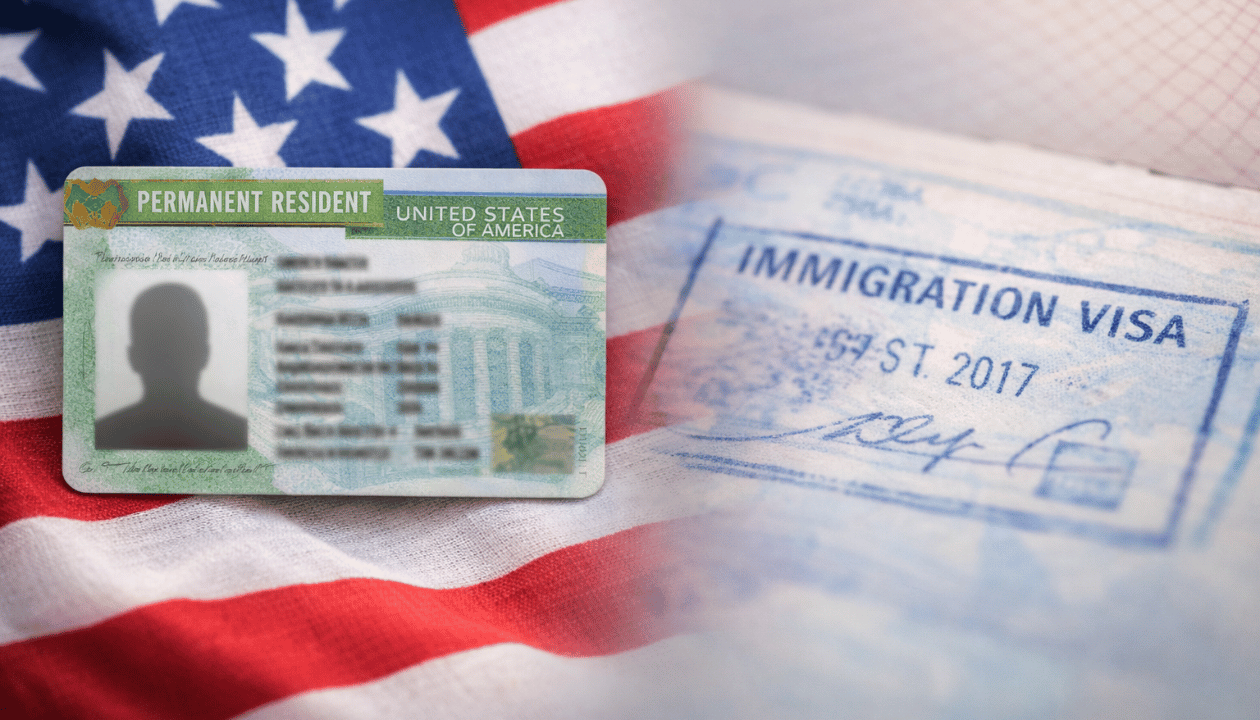
A green card unlocks a secure future in the United States, but “immigrant visa” and “green card” get confused constantly.
This mix-up leads to wrong processes, false expectations, and delays. An immigrant visa gets issued abroad by the State Department for U.S. entry. A green card proves you already hold lawful permanent resident status once inside.
The confusion makes sense: In FY 2025, the State Department issued over 650,000 immigrant visas, most recipients convert to green cards upon arrival, blending the terms in conversation.
At The Chidolue Law Firm, we clarify this difference so clients pick the right path and avoid costly slowdowns.
Let’s break it down clearly.
What an immigrant visa?
A U.S. visa is placed in a traveler’s passport and serves as a travel document to reach a U.S. port of entry, where the individual can request permission to enter the country. However, having a visa does not guarantee admission. Entry is determined by the Department of Homeland Security (DHS) through officers at U.S. Customs and Border Protection (CBP).
There are two main visa categories:
- Nonimmigrant visas – for temporary travel, such as tourism, study, or work
- Immigrant visas – for individuals who intend to live permanently in the United States
Immigrant Visa Categories and Latest Issuance Data
The most recent full fiscal year data (FY 2025) published by the U.S. Department of State shows how immigrant visas are distributed across major categories:
| Visa Category | Number of Visas Issued |
| Immediate Relatives | 280,522 |
| Family-Sponsored Preference | 212,184 |
| Employment-Based Preference | 56,789 |
| Diversity Visa (DV Lottery) | 51,927 |
| Special Immigrant Visas | 41,203 |
Why 2026 Numbers Matter:
- Annual caps = backlogs (F2A family waits now 2.5+ years)
- Country-specific processing varies widely
- FY 2026 demand already straining employment categories
These trends guide realistic planning, knowing limits prevents surprises.
What is a green card?
USCIS explains that having a green card, also called a Permanent Resident Card, allows you to live and work permanently in the United States.
U.S. law defines lawfully admitted for permanent residence as the status of having been lawfully accorded the privilege of residing permanently in the United States as an immigrant, with that status not having changed.
The green card is the physical proof of that status. Federal regulations list Form I 551 as the Permanent Resident Card and describe it as evidence tied to lawful permanent resident status.
This is why a green card is not called a visa. A visa is used to seek entry. A green card is used to prove your lawful permanent resident status after you have it. The law even separates the idea of admission from the idea of visa issuance.
Also, for work and identity checks, the immigration regulations recognize the Permanent Resident Card as a document that can establish both identity and employment authorization.
How do the two fit together?
If you are outside the United States, you often start with consular processing. A petition is usually filed first and must be approved by USCIS before the case can move forward.
After petition approval, the case is transferred to the National Visa Center for pre-processing, document collection, and interview scheduling at a U.S. embassy or consulate.
If the visa is approved, the embassy prints the immigrant visa in the passport and the person must enter the United States before that visa expires.
Then the green card step follows. State Department instructions explain that people issued an immigrant visa overseas must pay the USCIS immigrant fee, and that fee is for processing residency status and printing the Permanent Resident Card. The Form I 551 green card is then mailed to the U.S. address listed in the visa application.
While waiting for the physical green card, immigration regulations also recognize temporary proof. A foreign passport may contain a temporary I 551 stamp, or a temporary I 551 printed notation on a machine readable immigrant visa. These are treated as acceptable evidence for certain purposes, such as employment verification.
If you are already inside the United States and eligible, you may instead use adjustment of status. Federal regulations describe the creation of a record of lawful permanent residence through Form I 485, and they note the applicant must be physically present in the United States at the time of filing.
Start Your Immigration Journey with Confidence
The green card and immigrant visa process is not just paperwork. It is a legal pathway with strict rules, deadlines, and document requirements.
Working with an experienced immigration attorney can help you:
Make sure you are using the right process, consular processing or adjustment of status.
Avoid delays caused by missing steps at the National Visa Center stage or at the interview stage.
Plan for what happens after visa approval, including the immigrant fee and green card delivery.
At The Chidolue Law Firm, we handle family based, employment based, and humanitarian immigration matters. We help clients understand what they are applying for, what document they will receive, and what comes next.
Start Your Immigration Journey with Confidence
Don’t let a simple wording mistake slow down your case. Get clear guidance before you file or take your next step.
📞 Call The Chidolue Law Firm today at:
➡ 407-995-6567
➡ 678-325-1037
💬 For WhatsApp inquiries, contact us at:
➡ 404-333-8751
Let us help you move forward with confidence.