





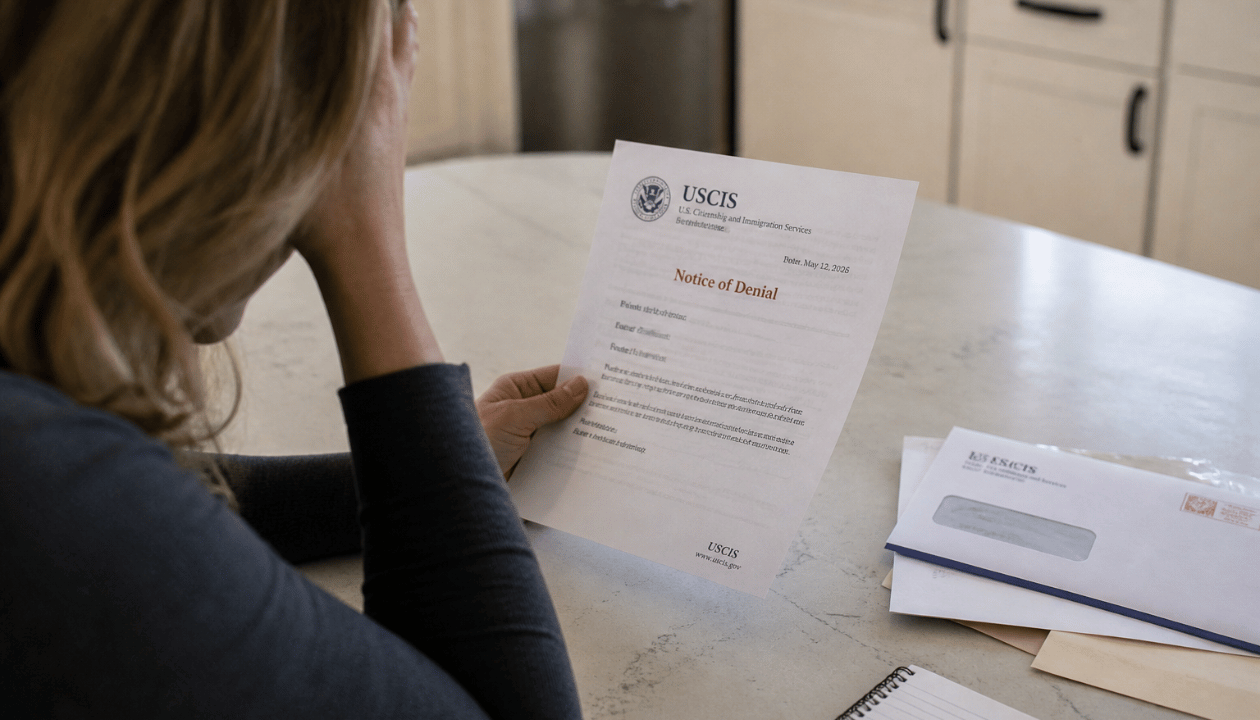
A client came in last week clutching a letter from USCIS like it was a death certificate. Her green card renewal application, a routine Form I-90 she’d filed eight months earlier, had come back denied. The letter referenced an arrest from 2014 that she’d told her old attorney about, and that he’d told her wouldn’t matter. Her hands were trembling. Her husband was at home with their three kids. And she asked me the question I get more than almost any other these days:
“Am I being deported?”
Listen, green card renewal after revocation 2026 is one of the most frightening situations a lawful permanent resident can face. And it’s getting more complicated, not less. So let’s walk through what’s actually happening, what your options look like, and what you should do tonight if you’re sitting in this situation.
What’s Actually Happening in 2026?
Here’s the current reality. Green card renewal in 2026 is no longer the rubber-stamp process it was five years ago, especially when there’s any complication in the file.
First, the basics on green card renewal fees. As of 2026, the filing fee for Form I-90, Application to Replace Permanent Resident Card, is $415 if you file online and $465 if you file by mail. The biometrics fee is now included in that filing fee, there’s no separate biometrics charge. USCIS has also largely stopped accepting personal checks, business checks, money orders, and cashier’s checks for paper filings. Most must now be paid via credit/debit card (Form G-1450) or ACH transfer (Form G-1650). If you mail in a check, your application gets rejected, and that’s a payment problem we are seeing constantly across green card renewal costs.
Second, USCIS is now using AI-driven tools to cross-reference social media, tax returns, employment history, and alien documentation when reviewing green card renewal applications. This is new in 2026. The system flags inconsistencies that an old human reviewer might never have caught. We’ve had clients with old, dismissed cases pulled into review because of this, old issues that they themselves had forgotten about.
Third, green card renewal status processing has slowed considerably. Standard renewals can range from 1.5 to 12 months, and we’re seeing some applicants wait longer than that. For renewals that involve any complication (past arrests, prior removal proceedings, or any inconsistency in the underlying file), the renewal process can take significantly longer. Critical waivers like Form I-601 can exceed 33 months in 2026.
Fourth, USCIS is more likely to revoke or deny a renewal than at any point in recent memory. Revocations are not just about fraud, they’re about anything USCIS later decides means you shouldn’t have had your status in the first place.
This is the environment. Let’s talk about what to do in it.
What “Revocation” Actually Means?
Let me translate. When people say “green card revocation,” they can mean a few different things:
- Outright revocation of permanent resident status. Usually triggered by fraud, willful misrepresentation, abandonment, or serious past arrests.
- Denial of the green card renewal. Your I-90 comes back rejected.
- Issuance of a notice to appear (NTA) in immigration court. This means the federal government wants to remove you from the country.
A notice to appear in immigration court often follows revocations. That NTA is what allows individuals to defend their lawful permanent resident status before a judge. So even if USCIS revokes your status or denies your renewal, the door is not necessarily closed, but you have to know how to walk through it.
Real talk: I see this constantly. People get a denial letter and assume it’s over. They stop opening their mail. Six months later they’re getting NTAs and ICE is at the door. The denial is not the end of your case. It’s the beginning of a different kind of fight. But you only get to fight if you respond on time.
Before You Even Get to Revocation: How to Renew Your Green Card the Right Way
Most permanent residents never face revocation, but a lot of permanent residents create their own problems by renewing badly. Let me walk you through the standard green card renewal process, because prevention is the cheapest defense you have.
A standard 10-year permanent resident card is typically valid for ten years from the expiration date printed on the front. You can renew a green card up to six months before that expiration date, and you should. Don’t wait until the day your green card expires to file. Plan ahead.
To renew your green card, you file Form I-90, the Application to Replace Permanent Resident Card. You can either file online through your USCIS online account or by mail through the postal service. Either way, you’ll receive a receipt notice with a receipt number to track your case. That receipt notice also extends your status while you wait. Keep it safe.
Most permanent residents can simply renew a green card without complications. But here’s what you need to know:
- Conditional permanent residents with a 2-year conditional green card cannot use Form I-90. You must file Form I-751 (or I-829 for investor cases) to remove conditions before your conditional green card expires.
- If you want to replace your green card because it was lost or stolen (not just expired), you also use the same form, but select a different reason on it.
- If your card is damaged or has incorrect information from a USCIS error, you may not have to pay any filing fee at all.
- If you change your mailing address while your case is pending, update USCIS immediately so you don’t miss any notices.
If you’re a returning client whose case has any complications, you should know about family-based petitions as well. Sometimes, a renewal that’s gone sideways is best handled in tandem with a fresh family-based filing strategy. The right strategy depends on the whole picture, not just the renewal form.
Real talk: I’ll be honest with you, the proof is in the pudding. The clients who keep their status through complicated renewals are the ones who came in with up to date information and complete supporting documents, and didn’t try to handle it alone. There are no shortcuts in this renewal process anymore.
Why USCIS Revokes or Denies Renewal in 2026?
Here’s what we’re seeing in our practice that triggers revocation or denial for permanent residents:
Old arrests that the original case missed. A client got their card in 2018. There was a 2011 arrest that wasn’t disclosed properly on the original application. It didn’t come up at the time. Now in 2026, USCIS’s AI tools cross-reference and flag it during the renewal process. The result: a NOID (notice of intent to deny) and possible revocation.
International travel during pending applications. Permanent residents who left the country for an extended period without a re-entry permit and now need a returning resident visa (SB-1) at a U.S. consulate to recover their lawful permanent resident status.
Fraud or misrepresentation findings. If revocation was due to fraud or certain criminal convictions, a waiver such as Form I-601 may be required to prove extreme hardship to a qualifying U.S. relative, and that waiver can take 33+ months in 2026.
Procedural mistakes. People are submitting outdated form editions or paying with a money order when USCIS no longer accepts them. Rejection. Sometimes worse. The expired card stays expired and gets you flagged in the system while you scramble to refile.
Abandonment of resident status. This is the one that catches green card holders who travel a lot. If you’ve been outside the United States for over a year without proper authorization, USCIS may treat your lawful permanent resident status as abandoned, even if you didn’t intend to give it up.
Your Options After a Revocation or Denial
Here’s where you actually have leverage, if you act fast.
1. File a Motion to Reopen or Reconsider (Form I-290B)
If your green card renewal application is denied, you’ll receive a letter explaining the reasons. Read it carefully. You can file a motion to have USCIS reconsider the decision if you believe the denial was a mistake. Submit Form I-290B within 30 days of the revocation notice. That deadline is brutal, there’s almost no flexibility. The motion review takes about 45 days, after which USCIS can either grant your request or refer the case to the Administrative Appeals Office (AAO), which usually takes another 6 months.
2. Request a Hearing Before an Immigration Judge
If a notice to appear (NTA) follows the revocation (and in 10 out of 10 of our cases involving full revocation, it does), you have the right to defend your permanent resident status in immigration court. Having an attorney who’s done this before makes the difference between keeping your status and losing it.
3. File for a Waiver (Form I-601)
If revocation was due to fraud or a serious criminal record, Form I-601 may be required to prove extreme hardship to a qualifying U.S. relative. In 2026, wait times for this waiver exceed 33 months. That’s not a typo.
4. Apply for a Returning Resident Visa (SB-1)
If your status was lost because you remained outside the U.S. for an extended period due to circumstances beyond your control, you can apply for a returning resident visa (SB-1) at a U.S. consulate. You’ll need to prove the reasons for the extended absence were beyond your control and that you intended to maintain your residency the entire time.
5. Re-File Form I-90 If the Issue Was Procedural
Sometimes a denial is just paperwork: wrong fee, missing signature, incorrect supporting documents. In those cases, you re-file with the correct form edition, the correct payment, and the required supporting documents. Always confirm you’re using the correct form for your category. Form I-90 to replace permanent resident card holders’ expiring 10-year cards. Form I-751 for conditional residents. Form I-829 for investor cases. Don’t assume your original filing was correct because someone else helped you with it.
Real talk: I had a client come in with a stack of paperwork three inches thick from a “consultant” who wasn’t an attorney. The man had charged her $2,400 to file her renewal, and used the wrong form. By the time she got to me, her expired green card was already months past its expiration date, and she’d almost lost her lawful status because someone who wasn’t qualified took her money. You should hire a lawyer because clearly the person you trusted was not equipped to do this. And I’m saying that most respectfully.
What This Looks Like in Real Cases
In our firm, we see patterns that come up again and again on renewal issues.
The “I forgot to mention it” pattern. A client renews her card ten years after the original was issued. There was a misdemeanor on her criminal record from 2009 that she didn’t list because her cousin told her it didn’t count. USCIS flags it. NOID arrives. Now we’re scrambling to file a response showing the disposition and rehabilitation, arguing this dismissed case shouldn’t trigger revocation of her lawful permanent resident status.
The “I’ll just do it myself online” pattern. A client tries to handle her renewal through her online account. She uses a form she shouldn’t have because she doesn’t realize she’s a conditional permanent resident, not a regular permanent resident, and she should have used I-751 instead of the I-90. Her filing gets rejected. Her conditional green card expires. Now she’s out of status while we untangle the mess.
The “long absence” pattern. Client travels back home to care for a sick parent. Stays abroad for an extended period. Returns to the U.S. and gets stopped at the airport. Customs says her green card’s validity is now in question. We end up needing to apply for a returning resident visa because by the time she came back, the absence had legally compromised her status. Many green card holders don’t realize that a permanent resident card is typically valid for ten years on its face, but the underlying status can be lost much faster if you’re outside the country too long.
Real talk: I see this so often it hurts. Permanent residents who’ve lived here for decades, raised kids here, paid taxes here, lose their status because they filed something themselves with bad information from the internet. The immigration services landscape in 2026 is brutal on people without representation. Don’t be one of those people.
What You Should Do Next
If you’re in this situation right now (denied renewal, NTA in hand, NOID just received), here’s what I’d tell you to do, in this order.
1. Read every piece of mail from USCIS. Every denial letter, every biometrics appointment notice, every receipt notice. Don’t shove it in a drawer. The receipt notice extends your lawful status in many cases, but only if you know it’s there.
2. Calendar your deadlines today. A motion to reopen or reconsider must be filed within 30 days. Miss it, and your options shrink dramatically. Write the dates on your fridge, alongside the date your card expires, if it hasn’t already.
3. Get your full record. Pull every USCIS record on your case. Pull your full criminal record if there’s any past arrest involved. Pull your tax returns. Pull your travel history. Build a complete picture before filing anything.
4. Get an experienced immigration lawyer involved immediately. I’m not saying this because I’m an attorney. I’m saying this because renewal after revocation is not a do-it-yourself situation in 2026. Professional legal help here is the difference between keeping your status and losing it. If you cannot afford counsel, look into pro bono organizations and fee waiver options based on financial hardship. A fee waiver is not automatic, you have to apply for it with Form I-912, but for many people, it’s the difference between filing and not filing at all.
5. Don’t lie to USCIS. Whatever happened, whatever you didn’t disclose the first time, the moment to come clean is now, with an attorney guiding you. Lying to immigration services after a revocation makes everything worse.
6. Preserve evidence of your ties to the U.S. Marriage certificate. Kids’ birth certificates. Tax returns. Pay stubs. Mortgage. Letters from family members and employers. Everything that shows your life here. Even if you ultimately need to renew your green card through a more complicated path, like a waiver or returning resident visa, this evidence is the foundation of your case.
If your green card expires before this gets resolved, schedule a consultation immediately. You miss 100% of the shots you don’t take, and every week you wait, your options to renew your green card shrink.
FAQs
How long does green card renewal take in 2026?
The standard green card renewal timeline is 1.5 to 12 months for routine cases, though some applicants are reporting wait times exceeding 12 months due to USCIS backlogs. If your case involves any complication (past arrests, removal proceedings, prior denials, or inconsistencies flagged by USCIS’s AI cross-referencing tools), expect it to take longer. Waivers like Form I-601 can exceed 33 months in 2026. The green card renewal timeline is not what it used to be.
What happens if my green card renewal application is denied?
You’ll receive a written notice from USCIS explaining the reasons for the denial. You can file Form I-290B to have USCIS reconsider the decision if you believe the denial was a mistake, but you must file within 30 days. The motion review takes about 45 days, after which USCIS can either grant your request or refer the case to the Administrative Appeals Office (AAO), which usually takes another 6 months. A notice to appear in immigration court often follows revocations. Don’t wait.
Can I renew my green card online if I have a criminal record?
You can technically file online through your USCIS account, but I would not recommend it. Any case involving past criminal convictions or arrests should be filed with an attorney reviewing the file first. The online portal does not give you the chance to explain context, attach disposition records properly, or anticipate what USCIS will flag in its AI review.
How much is the green card renewal fee in 2026?
The green card renewal fees for Form I-90 are $415 if you file online through the USCIS website and $465 if you file by mail. The biometrics fee is included, there is no separate biometrics appointment charge. USCIS no longer accepts personal checks or money order payments for paper filings. If you cannot afford the fee, you may qualify for a fee waiver by submitting Form I-912, but only under specific conditions, such as financial hardship or income at or below 150% of the federal poverty guidelines. Note: the fee waiver application is paper-only.
What documents do I need to renew my green card?
To renew your green card, you need Form I-90 (the Application to Replace Permanent Resident Card), a copy of your current green card (or expired card if it’s already expired), a valid government-issued ID, proof of legal name change if applicable (such as a marriage certificate), and evidence of continuous residency if requested. If your case involves any criminal history, you’ll also need certified disposition records, and any criminal history in your file should be reviewed by an attorney before submission. Always check the USCIS website for the most current list of required supporting documents before you submit your renewal form.
What if my green card expired a long time ago?
An expired green card does not revoke your permanent resident status, but it prevents you from being able to prove it, which can lead to complications with employment, international travel, and proving your legal status. Without a valid green card, you may struggle to prove your residency, obtain employment, or travel internationally. File Form I-90 immediately to get a new green card issued. If your expired card has been sitting that way for years and you’ve been outside the U.S. that whole time, the situation is more complicated and may involve a returning resident visa. An expired green card is fixable. An expired status is not.
Can a conditional permanent resident use Form I-90 to renew?
No. If you are a conditional permanent resident with a 2-year conditional green card, you must use Form I-751 (or Form I-829 for investor-based conditional residence) to remove conditions, not Form I-90. Filing the wrong form is one of the most common mistakes we see, and it leads to rejection and possible loss of status. If you’re not sure which form applies to you, ask an attorney before filing.
How do I check my green card renewal status, and what does the receipt notice do?
Once USCIS receives your I-90, you can monitor your case using the receipt number on your receipt notice. Log in to your USCIS online account to see updates on your green card renewal process. You can also call the USCIS Contact Center or visit a local USCIS office for additional information. The receipt notice USCIS sends after you file Form I-90, sometimes called a new receipt notice when it replaces an older one, extends your legal status as a permanent resident even after the expiration date on your card has passed. You can use the receipt notice along with your expired card to prove work authorization and travel eligibility (in most cases) until your new green card arrives. The receipt number is also your tracking key. If you change your address while your case is pending, update USCIS immediately so you don’t miss notices.
Don’t Let One Letter Decide Your Future. We Will Fight for You.
Renewal in 2026 is not the same beast it was even three years ago. The federal government is using AI tools, denying more cases, issuing NTAs more aggressively, and giving permanent residents less margin for error. But the rights you have to defend your status have not changed. The procedures to fight back have not changed. The waivers, the motions, and the immigration court hearings are all still available to permanent residents who act fast and act with the right help.
Your immigration journey doesn’t end with a denial letter. It just changes shape. If you’re holding one in your hand right now, schedule a consultation today. We will pull your full record, identify every option, file the right motions in time, and walk this path with you. Move now. The door is open. Walk in.
📞 Call The Chidolue Law Firm today at:
➡ 678-233-2170
➡ 678-325-1037
💬 For WhatsApp inquiries, contact us at:
➡ 404-333-8751
Same-day responses on most consultations. We serve clients in all 50 states.