





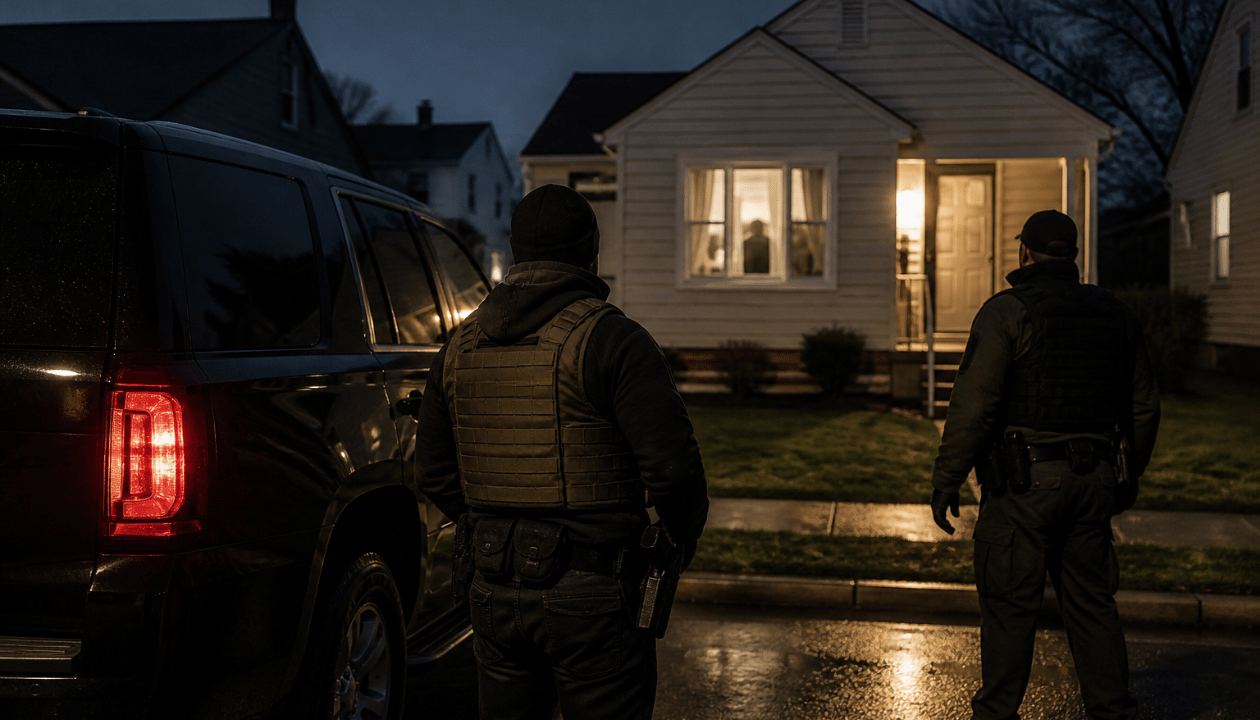
A client called me at 9:47 on a Tuesday night. Her hands were shaking so hard she dropped the phone twice before I could understand her. Three federal agents in tactical vests were sitting in an unmarked SUV across from her duplex. She was a legal resident with a green card. Her husband — one of millions of undocumented immigrants in this country with no criminal convictions, two US citizen kids asleep down the hall — was in the bathroom with the lights off.
“What do I do?”
Listen — I’m going to tell you what I told her, and what I’ve been telling clients constantly since December. Because the ICE aggressive tactics you’re seeing in 2026 are not the tactics of 2024. The aggressive tactics being used at people’s doors right now are genuinely different and the immigrants and families in this country need to know how to protect themselves.
What’s Actually Happening in 2026
In December 2025, the Trump administration launched what the Department of Homeland Security called “the largest immigration enforcement operation ever,” sending thousands of ICE officers and Customs and Border Protection (CBP) officers into the Twin Cities — the Minneapolis–Saint Paul metro area. The Trump administration framed Operation Metro Surge as a targeted action against criminal convictions in the Somali American community, but the data tells a different story.
Operation Metro Surge resulted in at least 3,789 immigration arrests, with fewer than one quarter of those detained having any criminal convictions. About 35% were “collateral” arrests — undocumented immigrants and others swept up because they were nearby, not because they were targeted by federal agents. Federal officers killed two US citizens, Renée Good and Alex Pretti, during ICE operations. Schools across multiple districts went into lockdown. Local businesses across the Twin Cities closed in solidarity, costing the cities more than $200 million in a single month.
The fallout was massive. DHS Secretary Kristi Noem was fired by the Trump administration in early March 2026 after two days of bipartisan grilling on Capitol Hill, and Senator Markwayne Mullin was confirmed as her replacement on March 23. Border czar Tom Homan announced the wind-down of Operation Metro in February. Immigration arrests across the country dropped by nearly 12% in the weeks that followed federal immigration officers at field offices in many cities scaled back operations.
But here’s the thing — the tactics didn’t disappear. The Trump administration scaled back in volume in the Twin Cities and shifted to other cities. In our practice, we’re getting calls weekly from clients who’ve been pulled over, surveilled at home, or grabbed from a parking lot. Customs and Border Protection officers are still active in cities far from any border. ICE raids in immigrant communities are still happening across the country. The aggressive tactics are not over. They’ve just stopped being a media event.
The ICE Tactics You Need to Know About
I’m going to walk through what federal immigration agents are actually doing not what the textbooks say, what real ICE agents are doing in real cases.
Home Entries Without a Valid Warrant
This is the big one. And it’s where most people give up rights they didn’t have to give up.
In May 2025, Immigration and Customs Enforcement released an internal memo claiming agents could enter homes of people with a final order of removal using only an administrative warrant a Form I-205. Let me translate. A judicial warrant is a court order signed by a federal judge. An administrative warrant is signed by an immigration officer basically, ICE giving itself permission. Historically, administrative warrants did not authorize forced entry into a home.
In January 2026, a US District Court ruled that an ICE agent’s forcible entry into a home with only an administrative warrant violated Fourth Amendment rights. The legal fight is still active. A federal officer may stand at your door waving a paper that says “warrant” and demand to come in — and that paper may not actually authorize them to enter. A lot of agents are counting on you not knowing the difference.
Real talk: If immigration officers are at your door with a paper, do not open that door. Ask them to slip the warrant under the door or hold it up to a window. A real judicial warrant says “United States District Court” at the top and is signed by a court not an immigration officer, not an immigration judge. If it’s signed by an ICE officer or says “Department of Homeland Security” at the top, it does not give them the right to enter your home without your consent. Once you let them in, the protection is gone.
Traffic Stops, Vehicle Surveillance, and ICE Tactics on the Road
This is where I’m seeing the most common contact in our practice right now. Federal immigration agents sometimes in unmarked vehicles, sometimes in vests labeled “POLICE” that make people think it’s local police officers from the local police department are conducting what they call traffic stops. In one Minnesota case in February 2026, an ICE officer approached a car at an elementary school parking lot and said agents were looking for someone named “Helen.” Three of the four passengers including a 52-year-old man from Ecuador were placed under arrest. None of them was named Helen. That’s how a “collateral” immigration arrest works.
Here’s what we’re seeing in our cases involving immigration enforcement operations:
- Federal agents follow vehicles for blocks before initiating stops
- Officers claim they’re looking for a specific person, then arrest whoever is in the car
- Agents scan license plates against DHS databases
- Officers use facial recognition tools on people stopped at the side of the road
- Federal agents smash windows and use force when occupants don’t roll them down
- Officers have deployed chemical irritants at protesters and bystanders during ICE operations
If federal immigration agents pull you over, you are not required to roll down your window all the way. Crack it. Show your driver’s license. You don’t have to answer questions about where you were born or how you entered the country. You have the right to remain silent and you should use it.
Workplace, School, and “Sensitive Location” ICE Raids
The bipartisan policy that limited ICE enforcement actions at hospitals, schools, churches, courthouses, and daycares was rescinded in 2025. Schools in Minnesota, including the Columbia Heights School District and others have been forced into lockdowns to protect students during ICE raids. Federal immigration agents have targeted individuals in medical facilities, places of worship, daycares, and funeral homes. Local businesses have closed for days at a time during ICE raids in immigrant communities, and operations across multiple cities have reshaped daily life for immigrants and their families.
We’ve had clients in our firm afraid to go to prenatal appointments. Afraid to take a sick kid to urgent care. Afraid to drop off and pick up at school. I want to be honest with you, this fear is not irrational. People are being arrested at hospitals. But sitting at home and avoiding medical care is also not a safety plan. It’s just a different kind of harm.
Surveillance, Use of Force, and ICE Custody Conditions
Federal immigration officers are using mobile apps to scan faces in the street and run them against Department of Homeland Security databases. They’re tapping into automatic license plate reader networks. Since December 2025, federal immigration agents have shot three people, killing two. ICE officers have racially profiled legal residents and US citizens. Federal agents have separated children from parents in mass deportations. Officers have deployed chemical irritants on public school property.
Once a person is taken into ICE custody, the picture gets harder. 2026 is on track to be one of the deadliest years for ICE custody on record. Detention facilities are overcrowded. In some places, including the Bishop Henry Whipple Federal Building in Minneapolis, attorneys have alleged that detainees are being held without access to counsel, in violation of due process rights. People in ICE custody have been transferred across state lines, sometimes within hours of arrest.
I’m not telling you this to scare you. I’m telling you because you need to plan for it.
Real talk: I had a client in last month green card for 14 years, two US citizen kids — who was pulled out of a parking lot because he “looked like” someone agents were searching for. Eleven hours in ICE custody before they confirmed he wasn’t the person they wanted. No phone call. No attorney. Your status will not necessarily protect you in the moment. What protects you is documentation, a plan, and someone with your lawyer’s number on speed dial.
How ICE Aggressive Tactics Are Affecting Communities Across the Country
The reach of these immigration enforcement operations goes well beyond the people directly arrested. Across the country, immigrant communities are reporting empty churches, empty pews, and empty parks. Schools in affected cities report higher absenteeism. Local businesses lose revenue when their workers and customers stop showing up. Asylum seekers — people who came to this country legally seeking protection — are afraid to go to their own court hearings.
Here’s what we’re seeing in immigrant communities in cities across the country:
- Parents are skipping prenatal appointments and pediatric visits
- Workers are leaving jobs they’ve held for years rather than risk a workplace raid
- Families are pulling kids out of after-school programs
- Asylum seekers are missing immigration court dates because they’re afraid of arrest
- Mixed-status families are making custody plans in case parents are taken into ICE custody
This is the human cost of mass deportations conducted with aggressive tactics and it’s hitting communities that include US citizens, legal residents, undocumented immigrants, and asylum seekers all in the same household.
Your Rights — In Plain Language
These rights apply to everyone in the United States — undocumented immigrants, asylum seekers, legal residents, and US citizens alike. That’s not me being political. That’s the Constitution.
At your home: You don’t have to open the door for ICE agents without a valid warrant signed by a court. Ask them to slide any warrant under the door. An administrative warrant (Form I-200 or I-205) does not give them legal authority to enter your home without consent. Say through the door: “I do not consent to your entry. I am exercising my right to remain silent. I want to speak with my attorney.” If they force entry, do not physically resist — document everything and get attorneys involved.
On the street or in your car: You have the right to remain silent. You can refuse to answer questions about where you were born, your immigration status, or how you entered the country. You can ask: “Am I being detained? Am I free to go?” You don’t have to consent to a search of your car or sign anything without an attorney.
At work: Immigration agents can enter public areas (lobbies, customer-facing parts of stores). They cannot enter private employee-only areas without a court-issued warrant or your employer’s permission.
Always: Carry an emergency contact card with your attorney’s number. Memorize your A-number if you have one. Keep copies of immigration documents in a safe place. Don’t lie or show false documents but you don’t have to volunteer information.
What This Looks Like in Real Cases
In our firm, we’re seeing patterns that should concern every immigrant family in this country.
The collateral arrest pattern. A client’s brother gets arrested by ICE agents at his construction site. The client — they’re picking him up for lunch — ends up under arrest too. The brother had a removal order from 2019. The client has a pending I-130 (the petition US citizens and green card holders file for family members) that’s been pending for two years. Now we’re fighting two cases instead of one.
The “we just want to talk” pattern. Federal officers knock, say they need to ask “a few questions,” and ask the resident to step outside “just to chat.” The resident steps onto the porch which, depending on jurisdiction, can be considered outside the home and is immediately handcuffed. Listen to me never, ever step outside to talk to ICE. 10 out of 10 times, the conversation can happen with the door closed.
The “by the time we got the call, it was too late” pattern. Family members wait six, eight, or twelve hours before calling an attorney because they don’t want to “make trouble.” By the time we get involved, the person has been transferred across state lines, into one of many detention facilities where attorney access is restricted, where they may have already been pressured to sign a stipulated removal order. Call an attorney within the first hour. Not the first day. The first hour.
Real talk: I’ve heard people say, “I’m here legally, this doesn’t apply to me.” It does. Legal residents have been picked up. People with valid work authorization have been swept up in collateral immigration arrests. The aggressive tactics being used right now don’t stop and check your paperwork before they make contact.
What You Should Do Next
Fear without a plan is just fear. Here’s what I’d tell you to do today, in this order.
1. Make a family emergency plan. Pick one trusted person ideally a US citizen — who has your immigration documents, your kids’ birth certificates, your attorney’s contact info, and signed authorizations for childcare and medical decisions. Talk to your kids about who they call if you don’t come home.
2. Get a “know your rights” red card. Carry it. You can hand it through a window without saying a word. The card asserts your right to remain silent and your right not to consent to entry without a court-signed warrant.
3. Get your eligibility screened by an immigration attorney. I cannot tell you how often a family comes to me after a detention asking about a case I could have filed two years ago — a U visa, a VAWA self-petition (where eligible spouses, children, or parents file on their own behalf without the abuser knowing), an asylum application for asylum seekers fleeing persecution, an adjustment of status (AOS) through a family member. The only way to remove this fear is to legalize yourself if you are eligible.
4. Save attorney contact info on every phone in the house. Including your kids’ phones. Make sure everyone in your circle knows who to call if you don’t come home.
5. Document everything. If federal immigration agents come to your home or pull you over, write down what you remember as soon as you safely can. Names, badge numbers, what they said, what time. We use this evidence in cases constantly.
If a family member has just been taken into ICE custody, if agents are watching your house, or if you’ve gotten an NTA (notice to appear), schedule a consultation today. The first 24 hours are the most important. Every hour you wait, options shrink.
FAQs
Can ICE enter my home without a court-issued warrant in 2026?
Legally, no — not without your consent. An administrative warrant (Form I-200 or I-205) signed by an immigration officer does not authorize forced entry. The Trump administration’s position is that I-205 warrants for people with final orders of removal allow forced entry, but this is being challenged in federal court, and at least one federal court has ruled the practice unconstitutional. ICE agents may still try, which is why you should never open the door, ask to see any warrant through a window, and explicitly state that you don’t consent.
What’s the difference between an administrative warrant and a court-issued warrant?
A court-issued warrant is signed by a federal or state court (not an immigration judge — those are administrative officials), names the place to be searched, and authorizes forced entry into private spaces. An administrative warrant is signed by an immigration officer, only authorizes arrest in public spaces, and historically has not allowed forced entry into homes. The header tells you a lot, “United States District Court” usually means it’s court-issued; “Department of Homeland Security” usually means administrative.
What rights do I have if ICE pulls me over?
You have the right to remain silent. You can refuse to answer questions about your immigration status, where you were born, or how you entered the country. Provide a driver’s license if you have one. You don’t have to consent to a search of your car. You can ask, “Am I being detained, or am I free to go?” Don’t run, don’t lie, and don’t show false documents — but you aren’t required to answer immigration-related questions.
Can ICE arrest me at a hospital, school, or church?
The policy that protected these “sensitive locations” was rescinded in 2025, and federal immigration agents have conducted enforcement at hospitals, schools, places of worship, and daycares during recent ICE operations. Legally, they can. Whether they will depends on circumstances and current enforcement priorities. This is why a family emergency plan matters for immigrants in every community.
What should I do if a family member is taken into ICE custody?
Call an immigration attorney within the first hour, not the first day. Get the person’s A-number (the nine-digit alien registration number) and which of the detention facilities they were taken to. Use the ICE online detainee locator. Don’t let them sign anything — including a stipulated removal order or voluntary departure form — without speaking to an attorney first. People in ICE custody are often pressured to sign documents that waive their rights.
Are US citizens being affected by ICE aggressive tactics in 2026?
Yes. There have been documented cases of US citizens being stopped, racially profiled, and held for hours during ICE operations across the country. Federal officers killed two US citizens during Operation Metro Surge. This is why every person in immigrant communities — regardless of status — should know their rights.
What rights do undocumented immigrants have during ICE raids?
Undocumented immigrants have the same Fourth and Fifth Amendment rights as anyone in the United States: the right to remain silent, the right to refuse a search without a court-issued warrant, and the right to an attorney. The right to remain silent is especially important, anything you say to ICE agents during a raid can be used against you in immigration court.
Take Control of Your Immigration Future Today
I’m not going to pretend this is a normal moment in immigration enforcement. It’s not. The aggressive tactics being used right now have caused deaths, separated families, and traumatized entire communities. The lawsuits are flying. Things are changing. But your safety and your case don’t wait for the political situation to improve.
The best thing you can do for yourself and your family right now is know your rights, have a plan, and find out if you have a path to legal status you haven’t been using.
If this post describes your situation, schedule a consultation. We will screen your case for every form of relief you might be eligible for, walk you through a family emergency plan, and tell you the truth about what you’re facing, even when the truth is hard. You miss 100% of the shots you don’t take. And in this environment, every month you spend frozen by fear is a month the federal government gets to write your story instead of you.
📞 Call The Chidolue Law Firm today at:
➡ 678-233-2170
➡ 678-325-1037
💬 For WhatsApp inquiries, contact us at:
➡ 404-333-8751
The door is open. Walk in.